
Category: CNC Machining Guide
A Swiss-type CNC lathe is often selected for the high-volume machining of small, slender and complex bar components. However, choosing the right machine requires more than comparing the number of axes, spindle speed or maximum machining diameter.
A machine with more tools and functions is not automatically the best choice. The correct configuration should be determined by the workpiece geometry, material, tolerance, required operations, production volume and target cycle time.
Before purchasing a 20 mm six-axis Swiss-type CNC lathe, buyers should carefully confirm the following seven questions.
1. What Parts Will the Machine Actually Produce?
Machine selection should begin with the workpiece rather than the machine specification sheet.
Buyers should prepare the following information:
Maximum raw bar diameter;
Finished-part diameter and length;
Workpiece material;
Length-to-diameter ratio;
Dimensional and geometric tolerances;
Surface-finish requirements;
Annual or monthly production quantity;
Target cycle time.
A 20 mm machine is generally intended for bar stock within its specified machining range, but the maximum bar diameter alone does not determine whether the machine is suitable.
A buyer should also check whether the part contains deep holes, cross holes, flats, grooves, threads, eccentric features or back-end operations. These features directly affect the required number of axes, live-tool positions and sub-spindle configuration.
Professional machine-tool purchasing guides similarly recommend defining the workpiece size, material and required operations before comparing machine models.
2. Should the Part Be Machined With or Without a Guide Bushing?
The guide bushing is one of the main structural features that distinguishes a Swiss-type lathe from a conventional fixed-headstock lathe.
During guide-bushing machining, the bar is supported close to the cutting point. This helps reduce workpiece deflection and vibration, making the configuration particularly suitable for slender parts and components requiring stable concentricity.
Guide-bushing machining is generally suitable for:
Long and slender shafts;
Small-diameter precision pins;
Parts with a relatively high length-to-diameter ratio;
Workpieces requiring stable continuous support.
Guide-bushless or chucker-type machining is often more suitable for short parts. It can reduce bar remnants and may allow the use of less precisely prepared bar stock, depending on the machine and application.
Major Swiss-type lathe manufacturers offer machines that can operate in both modes because the most suitable solution depends on the actual part geometry and bar material.
Therefore, buyers should not simply ask whether a machine has a guide bushing. They should ask: Which machining mode is more economical and stable for my specific workpiece?

3. Which Operations Must Be Completed in One Setup?
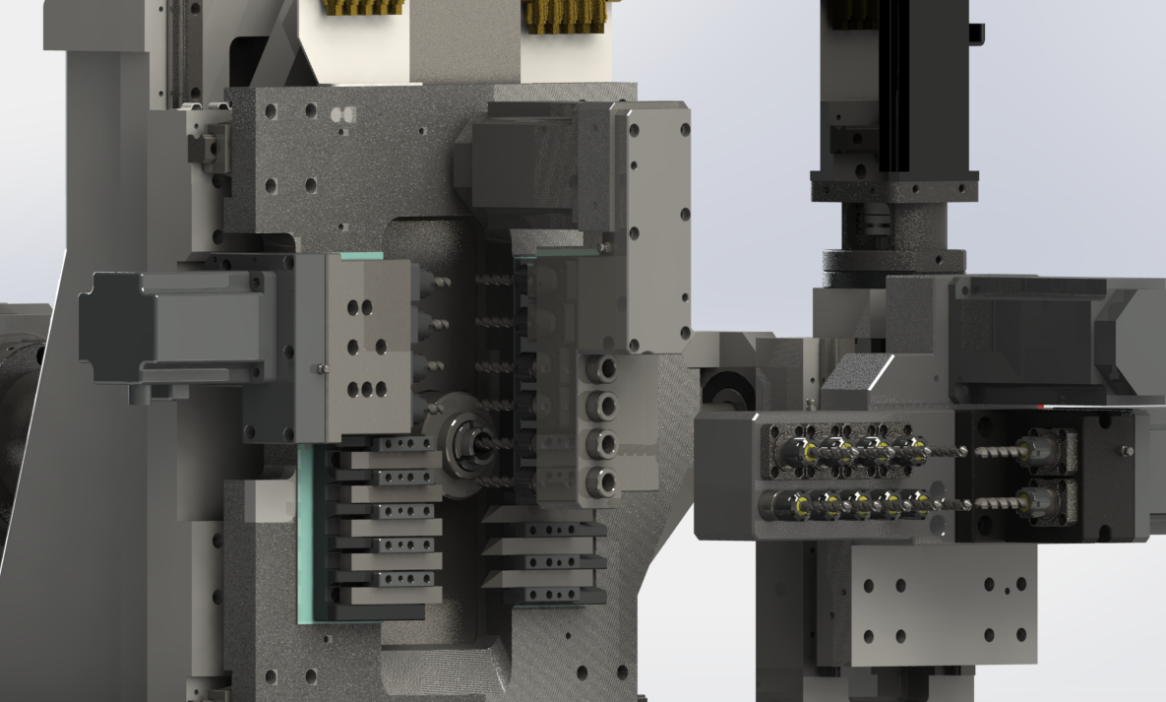
The main advantage of a six-axis Swiss-type CNC lathe is its ability to combine multiple processes on one machine.
Depending on the tooling configuration, the machine may perform:
External and internal turning;
Drilling and boring;
Threading and tapping;
Radial milling;
End-face milling;
Cross-hole drilling;
Grooving and parting-off;
Back-end machining.
If the part only requires basic external turning and drilling, a simpler machine may be sufficient.
However, if the workpiece includes side holes, flats, slots, off-center holes or back-end features, the machine will normally require live tooling, spindle indexing and a sub-spindle.
The buyer should prepare a complete machining-process list and confirm which operations can be completed in one clamping. This helps determine whether secondary machines and manual work can be eliminated.
4. Are Six Axes and a Sub-Spindle Necessary?
A typical six-axis Swiss-type lathe may use an axis configuration such as:
X1, Y1 and Z1 for the main-spindle side
X2, Y2 and Z2 for the sub-spindle side
The additional Y-axis on the sub-spindle side can support more complex backworking operations, including back milling, cross drilling and tapping.
A sub-spindle can receive the part after cutoff and complete the rear-side features without manual reclamping. On suitable machines, main-spindle and sub-spindle operations can also overlap, helping reduce the total production cycle. Official Tsugami specifications, for example, describe simultaneous main- and sub-spindle machining and overlapping back-milling operations as methods of reducing cycle time.
Nevertheless, six axes should not be selected only because the configuration sounds more advanced. Buyers should evaluate whether the planned workpieces actually require:
Complex backworking;
Multiple side-machining directions;
Simultaneous main- and sub-spindle operation;
Several powered tools;
Frequent production of complex parts.
5. Does a Higher Spindle Speed Guarantee Higher Productivity?
Spindle speed is important, especially when machining small-diameter parts, but it does not determine productivity by itself.
The actual cycle time also depends on:
Spindle acceleration and deceleration;
Rapid traverse speed;
Tool arrangement;
Number of tool changes;
Cutting parameters;
Main- and sub-spindle synchronization;
Bar-feeder response;
Chip removal;
Operator setup time.
A machine with a high maximum spindle speed may still have a long cycle time if the tool arrangement is inefficient or the program contains excessive idle movement.
For this reason, buyers should request a workpiece trial or cycle-time evaluation based on an actual drawing rather than comparing spindle speed alone.
6. How Should Machining Accuracy Be Verified?
Catalog accuracy and actual production stability are not always the same.
Before ordering a machine, the buyer should define the acceptance requirements, such as:
Critical dimensional tolerances;
Roundness and cylindricity;
Concentricity;
Position tolerance;
Surface roughness;
Repeatability;
Continuous-production stability;
Inspection method and measuring equipment.
For high-volume production, it is advisable to test multiple consecutive workpieces after the machine reaches a stable operating temperature. This provides more useful information than measuring only one sample produced immediately after setup.
Thermal stability is particularly important because changes in the spindle, ball screws and machine structure may influence dimensional consistency during long production runs.
The D206 series is promoted by its manufacturer with a thermal-deviation compensation function, but the final acceptance requirements should still be established through an agreed workpiece trial and technical specification.
7. What Is Included in the Complete Machine Project?
The machine price is only one part of the total investment.
A complete Swiss-type lathe project may also require:
Automatic bar feeder;
Guide bushings and collets;
Fixed and live-tool holders;
High-pressure coolant system;
Chip conveyor or chip collection system;
Oil-mist collector;
Parts collector;
Transformer or voltage adaptation;
Cutting tools;
Installation and commissioning;
Operator and programming training;
Spare parts;
Remote or on-site technical support.
Buyers should clearly distinguish between standard equipment and optional equipment.
They should also confirm the electrical supply, compressed-air requirements, floor space, foundation conditions, delivery scope and warranty terms before placing the order.
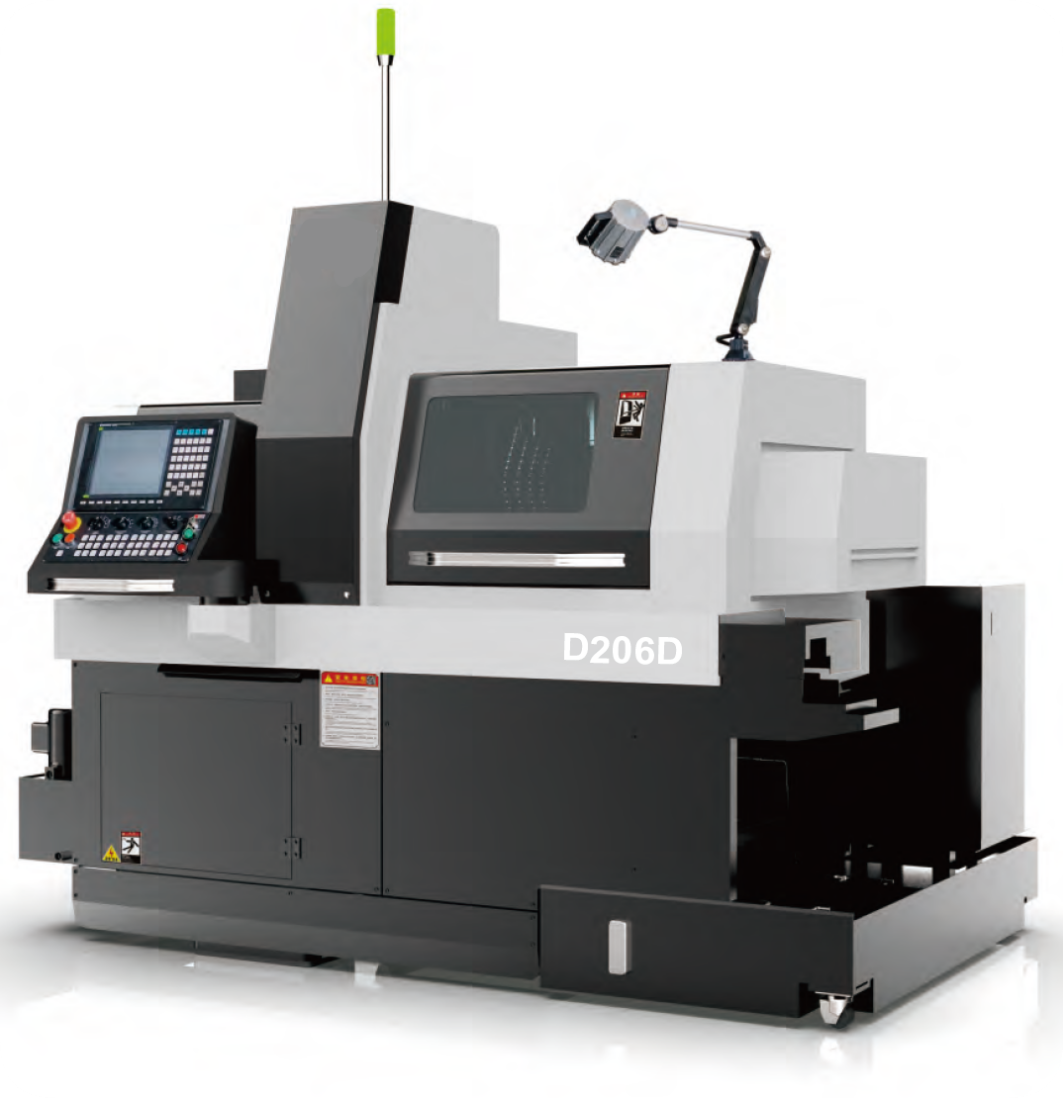
D206D as a 20 mm Six-Axis Example
According to the manufacturer’s current product information, the D206D is a six-axis Swiss-type CNC lathe with a maximum machining diameter of 20 mm.
Published configurations include:
X1, Y1, Z1, X2, Y2 and Z2 axes;
Electric main spindle and sub-spindle;
Live tooling;
Up to 29 tool positions;
Main- and sub-spindle machining;
Maximum spindle speeds of up to 10,000 r/min;
Turning, drilling, tapping, milling and backworking capabilities.
The manufacturer currently lists both FANUC and SYNTEC versions. Some motor powers and component configurations differ between the two versions, so buyers should confirm the final technical specification according to the selected control system and order configuration.
The D206-type configuration may be considered for electronic connectors, precision shafts, automotive components, small valve parts, communication components, precision fasteners and other complex bar-turned parts, subject to workpiece evaluation.
A Practical Purchasing Checklist
Before requesting a final quotation, the buyer should provide:
- A 2D or 3D workpiece drawing;
- Raw-material type and bar diameter;
- Critical tolerances and surface-finish requirements;
- Required monthly or annual production volume;
- Target cycle time;
- Required machining processes;
- Preferred CNC control system;
- Destination-country voltage and frequency;
- Required auxiliary equipment;
- Workpiece sample and acceptance requirements.
Providing complete information allows the machine supplier to recommend a suitable configuration, prepare a more accurate quotation and evaluate the machining process before production begins.
Conclusion
The correct Swiss-type CNC lathe should not be selected only by comparing price, maximum diameter, axis quantity or spindle speed.
A reliable purchasing decision should be based on the actual workpiece, machining process, production quantity, accuracy requirement and complete project cost.
For buyers considering a 20 mm six-axis machine, the most effective first step is to send the workpiece drawing, material, tolerance and production target to the supplier for a technical evaluation. This helps determine whether the selected machine and tooling configuration can complete the part efficiently, consistently and economically.
Email : sales8@yuhenmachine.com
WhatsApp: +86 17200315617
Post time: Jul-24-2026

