
Pine Zhong
WhatsApp:+86 15010397162 E-mail:sales6@yuhenmachine.com
When purchasing an EDM drilling machine, one of the first decisions you may face is whether to choose a manual EDM drilling machine or a CNC EDM drilling machine.
Both types use electrical discharge machining to produce small, precise holes in electrically conductive materials. However, their differences in control method, automation, productivity, positioning accuracy, and operator requirements can have a significant impact on your production process.
For a workshop producing a small number of holes or handling relatively simple jobs, a manual EDM drilling machine may be sufficient. For manufacturers processing multiple holes, complex workpieces, or requiring repeatable production, a CNC EDM drilling machine can provide major advantages.
So, which one should you buy?
The answer depends on your workpiece requirements, production volume, hole accuracy, automation needs, and budget.
What Is an EDM Drilling Machine?
An EDM drilling machine, also known as a small-hole EDM machine or EDM hole drilling machine, uses controlled electrical discharges to remove material from a conductive workpiece.
Unlike conventional drilling, the electrode does not need to mechanically cut through the material. Instead, repeated electrical sparks erode the workpiece and create the hole.
This makes EDM drilling particularly useful for materials and applications where conventional drilling can be difficult, including:
● Hardened steel
● Tool steel
● Carbide and other conductive hard materials
● Turbine components
● Dies and molds
● Automotive components
● Aerospace components
● Precision parts
● Small and deep holes
EDM drilling is especially valuable when the required hole is very small, deep, or difficult to produce using conventional cutting tools.
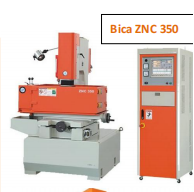
Manual EDM Drilling Machine vs CNC EDM Drilling Machine
The biggest difference between the two machines is how the machining process is controlled.
A manual EDM drilling machine relies more heavily on the operator for positioning, setup, and machining adjustments.
A CNC EDM drilling machine uses a computerized numerical control system to control the movement and machining process according to programmed instructions.
Here is a simplified comparison:
|
Feature |
Manual EDM Drilling Machine |
CNC EDM Drilling Machine |
| Control | Manual operation | CNC control |
| Operator involvement | High | Lower |
| Hole positioning | Operator-controlled | Program-controlled |
| Automation | Limited | High |
| Repeatability | Depends heavily on operator | High |
| Multi-hole machining | Less efficient | More efficient |
| Complex positioning | More difficult | Easier |
| Production volume | Low to medium | Medium to high |
| Initial investment | Generally lower | Generally higher |
| Programming requirement | Minimal | Requires CNC programming |
| Suitable for | Simple jobs and flexible production | Precision and repetitive production |
The table provides a general comparison, but the actual performance depends on the specific machine configuration.
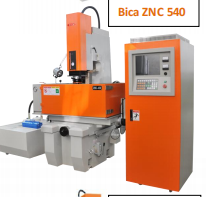
1. Manual EDM Drilling Machine: Advantages and Limitations
A manual EDM drilling machine is designed to give the operator direct control over the machining process.
The operator typically positions the workpiece, aligns the electrode, adjusts the machining parameters, and monitors the drilling process.
Advantages of Manual EDM Drilling Machines
Lower initial investment
One of the main reasons buyers consider manual EDM drilling machines is their relatively simple configuration. With fewer automation and CNC components, the initial purchase cost can be lower.
Simple operation
For operators familiar with EDM processes, a manual machine can be straightforward to operate, especially for simple hole-drilling jobs.
Good flexibility for small-batch work
If your workshop frequently changes workpieces and does not require hundreds of identical holes, manual operation can be practical.
Suitable for repair and tool-room applications
Manual EDM drilling machines can be useful for maintenance departments, tool rooms, mold repair, and general-purpose machining environments.
Limitations
The main limitation is operator dependence.
When hole locations must be positioned manually, productivity and repeatability can depend strongly on the operator’s experience.
This can become a problem when:
● A workpiece contains many holes
● Hole positions must be repeated accurately
● Multiple identical parts are produced
● Production volume increases
● The machining process needs greater automation
For these applications, CNC control can offer a significant advantage.
2. CNC EDM Drilling Machine: Advantages and Limitations
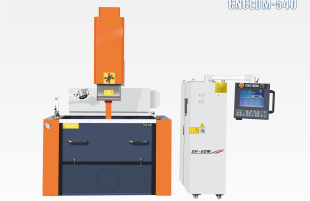
A CNC EDM drilling machine integrates numerical control into the EDM drilling process.
Instead of manually positioning every hole, the operator can define machining coordinates and parameters through the CNC control system.
The machine can then move to programmed positions and perform the drilling cycle automatically.
Advantages of CNC EDM Drilling Machines
Higher positioning repeatability
One of the biggest benefits of CNC control is consistent positioning.
Once the machining coordinates are programmed, the machine can repeat the same movement pattern for multiple workpieces.
This is particularly useful for components containing numerous holes.
Higher productivity
CNC automation can reduce manual positioning and setup time.
For production environments where many holes must be drilled, this can significantly improve overall productivity.
Better for complex workpieces
Some components require holes at different coordinates or require a specific machining sequence.
Programming these operations into a CNC system can make the process much easier than manually positioning each hole.
Reduced operator workload
The operator does not need to manually control every positioning movement.
Instead, the operator can focus more on setup, electrode management, workpiece inspection, and process monitoring.
Better production consistency
For manufacturers producing batches of similar components, CNC control can help maintain consistent machining procedures from one part to another.
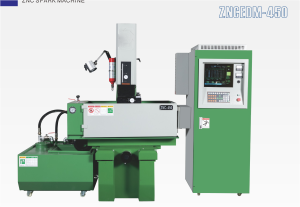
3. Which Machine Is More Accurate?
It is tempting to say that a CNC EDM drilling machine is always more accurate, but this is an oversimplification.
The actual machining accuracy depends on the entire machine system, including:
● Machine structure
● Guideways
● Servo system
● CNC controller
● Electrode quality
● Workpiece setup
● EDM power supply
● Dielectric flushing
● Machining parameters
● Operator technique
However, CNC control provides an important advantage in positioning repeatability and automated movement.
For example, suppose you need to produce 50 holes at predefined coordinates.
With a manual machine, the operator has to repeatedly locate each position.
With a CNC machine, the coordinates can be programmed and repeated automatically.
Therefore, when the job requires many precisely positioned holes, CNC is generally the more efficient choice.
4. What About Deep-Hole EDM Drilling?
Deep-hole EDM drilling is one area where machine configuration becomes particularly important.
The difficulty of deep-hole machining is not simply the depth itself. As the hole becomes deeper, effective flushing and removal of machining debris become increasingly important.
Poor flushing can lead to:
● Unstable electrical discharges
● Reduced machining efficiency
● Electrode wear
● Poor hole quality
● Increased machining time
Therefore, when selecting an EDM drilling machine for deep-hole applications, buyers should look beyond whether the machine is manual or CNC.
Important specifications include:
Maximum drilling depth
Make sure the machine’s rated drilling depth is sufficient for your actual components.
Electrode diameter range
The available electrode range determines what hole sizes the machine can produce.
Flushing system
Effective dielectric flushing is particularly important for deep holes.
Servo control
Stable servo control helps maintain the appropriate machining gap during EDM processing.
CNC axis configuration
For multiple-hole and complex-position applications, CNC-controlled axes can substantially improve productivity.
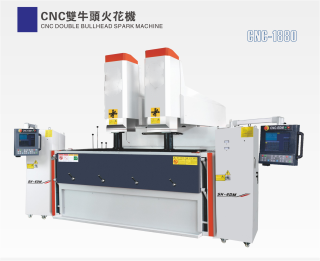
5. When Should You Buy a Manual EDM Drilling Machine?
A manual EDM drilling machine may be a good choice if your workshop has the following requirements:
Choose Manual EDM if:
● You have a limited machining budget.
● Your production volume is relatively low.
● You mainly process simple workpieces.
● Hole positioning is not extremely complex.
● You frequently handle one-off or repair jobs.
● You already have experienced EDM operators.
● You do not need extensive automation.
For example, a small tool room may only need to drill several holes in different workpieces each day.
In this situation, investing in a highly automated CNC system may not provide enough additional value to justify the higher investment.
6. When Should You Buy a CNC EDM Drilling Machine?
A CNC EDM drilling machine becomes more attractive when production requirements become more demanding.
Choose CNC EDM if:
● You produce multiple identical components.
● Your workpieces contain many holes.
● Hole positioning must be highly repeatable.
● You need to reduce manual operation.
● Production efficiency is important.
● You regularly process complex workpieces.
● You want to increase automation.
● You expect production volume to increase in the future.
For example, imagine a manufacturer producing a component with 30 or 50 small holes.
With manual positioning, the operator must repeatedly locate each hole.
With CNC control, the hole coordinates can be programmed once and reused for subsequent components.
The time savings can become substantial as production volume increases.
7. Manual vs CNC EDM: What About Cost?
Cost is often one of the most important factors when purchasing a machine.
A manual EDM drilling machine generally has a simpler control system and fewer automated functions, so its initial purchase price can be lower.
A CNC EDM drilling machine typically costs more because it incorporates:
● CNC controller
● Servo motors
● Automated positioning
● CNC software
● Additional sensors or control systems
● More sophisticated machine components
However, purchase price should not be the only factor in your decision.
You should also consider the total cost of ownership.
For example:
Lower machine price does not necessarily mean lower production cost.
If a manual machine requires significantly more operator time for every workpiece, its labor cost may become important over several years.
Conversely, if your production volume is low, the additional automation of a CNC machine may not generate enough savings to justify the initial investment.
8. Consider the Total Cost of Ownership
When comparing machines, consider at least five factors:
1. Machine purchase price
How much do you need to invest initially?
2. Labor cost
How much operator time is required for each component?
3. Production efficiency
How many workpieces or holes can the machine process within a given period?
4. Maintenance cost
Consider the complexity and maintenance requirements of the control and mechanical systems.
5. Future production requirements
Will your production volume increase?
A machine that is sufficient today may become a bottleneck several years later.
9. Operator Skill Requirements
Manual EDM drilling machines generally require more direct operator involvement.
The operator needs to understand:
● Workpiece positioning
● Electrode alignment
● EDM parameters
● Flushing
● Machining stability
● Electrode wear
● Hole quality
A CNC machine does not eliminate the need for a skilled operator, but it can reduce repetitive manual positioning work.
The operator can instead focus on:
● Programming
● Workpiece setup
● Parameter optimization
● Quality inspection
● Production monitoring
Therefore, the choice also depends on the skill structure of your workshop.
10. Don’t Choose CNC Just Because It Is More Advanced
CNC does not automatically mean “better” for every application.
This is an important point when purchasing an EDM drilling machine.
If your workshop mainly performs:
● Occasional hole drilling
● Maintenance work
● Mold repair
● One-off jobs
● Low-volume production
a manual machine may provide a better return on investment.
On the other hand, if you are running continuous production and need consistent positioning and high efficiency, CNC is usually worth considering.
The right question is not:
“Which machine is more advanced?”
The better question is:
“Which machine is appropriate for my production requirements?”
Manual or CNC EDM Drilling Machine: Quick Decision Guide
You can use the following simple guide:
|
Your Requirement |
Recommended Choice |
| Low production volume | Manual |
| Low initial budget | Manual |
| Repair and maintenance work | Manual |
| Simple hole positioning | Manual |
| Many holes per workpiece | CNC |
| High production volume | CNC |
| Repetitive production | CNC |
| Complex hole coordinates | CNC |
| Reduced operator intervention | CNC |
| Higher automation requirements | CNC |
| Future production expansion | CNC |
11. What Should You Check Before Buying?
Regardless of whether you choose manual or CNC, don’t make your decision based only on the machine’s headline price.
Ask the supplier about the following specifications:
Machining capability
● Minimum hole diameter
● Maximum hole diameter
● Maximum drilling depth
● Maximum workpiece size
● Maximum workpiece weight
● Positioning accuracy
● Repeatability
● EDM power supply
● Servo control
● Electrode wear
● Machining speed
● Dielectric pump capacity
● Flushing pressure
● Through-electrode flushing
● Tank capacity
● Filtration system
Machine performance
Flushing system
CNC system
For CNC models, check:
● Number of controlled axes
● CNC controller brand
● Programming method
● Coordinate system
● Memory capacity
● Automatic positioning functions
After-sales support
Also consider:
● Warranty period
● Remote technical support
● Spare parts availability
● Installation and commissioning
● Operator training
A reliable supplier should be able to provide clear technical specifications rather than simply giving you a machine price.
Final Verdict: Manual or CNC EDM Drilling Machine?
There is no universal answer.
A manual EDM drilling machine is generally more suitable for small workshops, repair work, low-volume production, and buyers who prioritize a lower initial investment.
A CNC EDM drilling machine is generally a better choice for repetitive production, multiple-hole components, complex positioning, higher productivity, and manufacturers planning to increase automation.
The most important factors are not simply the machine price or whether the machine is manual or CNC.
Instead, evaluate your:
● Hole diameter
● Hole depth
● Workpiece material
● Hole quantity
● Positioning requirements
● Production volume
● Labor costs
● Accuracy requirements
● Future production plans
If you are still unsure, provide your workpiece drawing, hole diameter, hole depth, material, quantity of holes, and expected production volume to a machine supplier. A professional supplier should be able to recommend the appropriate EDM drilling configuration based on your actual application.
The best EDM drilling machine is not necessarily the most expensive or most automated machine—it is the one that provides the right balance of accuracy, productivity, flexibility, and investment for your specific production needs.
Post time: Sep-02-2026

